
Problems of modern teacher education
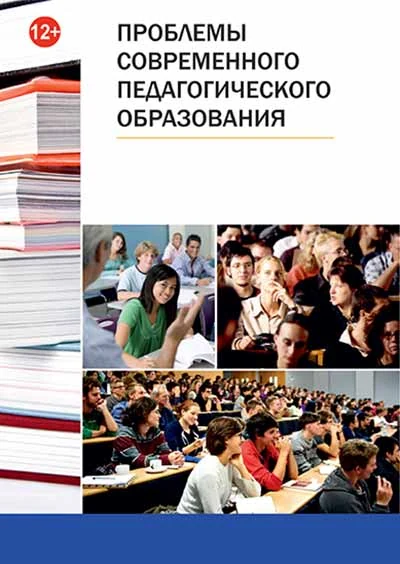
Publisher information
Founder: V.I. Vernadsky Crimean Federal University.
Media: Certificate of registration of mass media PI № FS 77-61807 dated 05/18/2015. Title (according to the media): Problems of modern teacher education. Approximate subject and/or specialization: Scientific. The form of periodic distribution (type – for a periodical print edition): Periodical print edition, collection.
List of Higher Attestation Commission: Included in the «List of Leading Peer-Reviewed Publications of the Higher Attestation Commission of the Russian Federation» in the following scientific fields: Pedagogical Sciences; Psychological Sciences.
RINC: Published on the eLIBRARY platform with indexing in RINC in accordance with Agreement No. 171-03/2014 (https://www.elibrary.ru/title_about_new.asp?id=50652).
ISSN: Identification number of the print version: ISSN 2311-1305.
Editorial and publisher’s address:
298635, Republic of Crimea, Yalta, Sevastopolskaya Street, 2a
Editor-in-chief
Gluzman A.V., doctor of pedagogical Sciences, Professor, Academy of the Humanities and Pedagogics (branch) V.I. Vernadsky Crimean Federal University in Yalta
Editorial board
Gorbunova N.V., doctor of pedagogical Sciences, Professor, Academy of the Humanities and Pedagogics (branch) V.I. Vernadsky Crimean Federal University in Yalta
Fetisov A.S., Doctor of Pedagogical Sciences, Associate Professor, Federal State Budgetary Educational Institution of Higher Education «Voronezh State Pedagogical University»
Popova V.I., Doctor of Pedagogical Sciences, Professor, Federal State Budgetary Educational Institution of Higher Education «Orenburg State Pedagogical University»
Vlasova T.I., doctor of pedagogical Sciences, Professor, Academy of the Humanities and Pedagogics (branch) V.I. Vernadsky Crimean Federal University in Yalta
Boginskаyа Y.V., doctor of pedagogical Sciences, Professor, Academy of the Humanities and Pedagogics (branch) V.I. Vernadsky Crimean Federal University in Yalta
Shevchenko O.K., Doctor of Philosophical Sciences, Associate Professor, V.I. Vernadsky Crimean Federal University
Gordienko T.P., Doctor of Pedagogical Sciences, Professor, State Budgetary Educational Institution of Higher Education of the Republic of Crimea «Crimean Engineering and Pedagogical University named after Fevzi Yakubov»
Sherayzina R.M., Doctor of Pedagogical Sciences, Professor, Federal State Budgetary Educational Institution of Higher Professional Education «Novgorod State University named after Yaroslav the Wise»
Donina I.A., Doctor of Pedagogical Sciences, Associate Professor, Federal State Budgetary Educational Institution of Higher Professional Education «Novgorod State University named after Yaroslav the Wise»
Shtets A.A., Doctor of Pedagogical Sciences, Professor, Sevastopol State University
Petrushin V.I., Doctor of Pedagogical Sciences, Professor, Moscow Pedagogical State University
Egorova Yu.N., Doctor of Pedagogical Sciences, Professor, Samara State University
Vovk E.V., Candidate of Pedagogical Sciences, Associate Professor, V.I. Vernadsky Crimean Federal University
Vezetiu E.V., Candidate of Pedagogical Sciences, Associate Professor, Academy of the Humanities and Pedagogics (branch) V.I. Vernadsky Crimean Federal University in Yalta
Lebedeva O.V., Doctor of Psychological Sciences, Associate Professor, Federal State Budgetary Educational Institution of Higher Education “Nizhny Novgorod State Pedagogical University named after Kozma Minin”
Cherny E.V., Doctor of Psychological Sciences, Professor, V.I. Vernadsky Crimean Federal University
Kalina N.F., Doctor of Psychological Sciences, Professor, V.I. Vernadsky Crimean Federal University
Pavlenko V.B., Doctor of Psychophysiological Sciences, Professor, Doctor of Psychological Sciences, Professor, V.I. Vernadsky Crimean Federal University
Bura L.V., Candidate of Psychological Sciences, Associate Professor, Academy of the Humanities and Pedagogics (branch) V.I. Vernadsky Crimean Federal University in Yalta
Andreev A.S., Doctor of Psychological Sciences, Professor, State Budgetary Educational Institution of Higher Education of the Republic of Crimea «Crimean Engineering and Pedagogical University named after Fevzi Yakubov»
Savenkov A.I., Doctor of Psychological Sciences, Doctor of Pedagogical Sciences, Professor, Moscow City Pedagogical University
Vasilenko I.V., Candidate of Psychological Sciences, Associate Professor, Sevastopol State University
Sultanova I.V., Candidate of Psychological Sciences, Associate Professor, Sevastopol State University
Volkova I.P., Doctor of Psychological Sciences, Professor, Federal State Budgetary Educational Institution of Higher Education «Russian State Pedagogical University named after A.I. Herzen»
Contact information
Editorial and publisher’s address:
298635, Republic of Crimea, Yalta, Sevastopolskaya Street, 2a
Journal scope
5.3.1 – General psychology, personality psychology, history of psychology
5.3.4 – Educational psychology, psychodiagnostics of digital educational environments
5.8.1 – General pedagogy, history of pedagogy and education
5.8.2 – Theory and methodology of teaching and upbringing (by fields and levels of education)
5.8.3 – Correctional pedagogy (deaf pedagogy and blind pedagogy, intellectual disability pedagogy and speech therapy)
5.8.7 – Methodology and Technology of Vocational Education
Peer review policy
The editorial board carries out an initial review of the materials to determine whether they are consistent with the subject matter of the periodic printed publication and the established formatting requirements. If the article meets the applicable requirements and subject matter, it is registered in the register.
The manuscript submitted by the author(s) is forwarded by the editorial board, based on the decision of the chief editor, for expert review by a reviewer who oversees the relevant field of science. Additional review may be assigned if the article is of an interdisciplinary or controversial nature. The editorial board checks all articles using the Antiplagiarism system. If the text’s originality is below 75%, the article is sent back to the author for revision, with the corresponding justification.
The review process is conducted confidentially and is of a closed nature.
The review of scientific articles is carried out on the basis of anonymous review: the manuscript is submitted to the reviewer without indicating the authors’ surnames or any other information that would allow the authors to be identified.
The reviewer is notified that the manuscript submitted to them is the private property of the author(s). The reviewer is not allowed to copy the manuscript in order to use the material for their own needs or to pass it on to a third party.
The review period for the manuscript is no more than 7 working days from the moment the manuscript is submitted to the reviewer.
The reviewer can provide three types of recommendations regarding the article: to recommend for publication, not to recommend for publication, or to recommend for publication after addressing the comments. If the article is not recommended for publication, a reasoned critical conclusion must be provided. If the article is recommended after addressing the comments, comments should be made for the article’s revision, and the need for subsequent review by the reviewer should be indicated.
If the reviewer has indicated the need to make changes to the manuscript, the author may partially or fully agree with the reviewer’s opinion, revise the article, and resubmit the manuscript.
A second negative review of the article is grounds for the final rejection of the article.
The decision to publish the manuscript is made by the editorial board and approved by the chief editor.
The following are not allowed for publication:
a) articles that are not properly formatted and whose authors refuse to make technical improvements to the articles;
b) articles whose authors do not respond to the reviewer’s constructive comments with their implementation or refutation;
c) articles that do not contain new information or are not related to scientific activity.
The editorial board reviews all incoming materials for the purpose of expert assessment. All reviewers are recognized specialists in the subject matter of the materials being reviewed.
The authors of the manuscript are responsible for the accuracy of the results of the research conducted, as well as for the selection and accuracy of the facts, quotes, statistical data, and other information provided. Deliberately erroneous or falsified statements are unacceptable. The authors must guarantee that the research results presented in the submitted manuscript are entirely original. Borrowed fragments or statements must be properly cited, with mandatory attribution to the author and the original source. Excessive borrowing, as well as plagiarism in any form, including unacknowledged quotations, paraphrasing, or appropriation of the results of others’ research, is unethical and unacceptable. Authors are prohibited from using AI in conducting research and preparing the submitted materials, including data collection and analysis, creation, revision, translation, editing and proofreading of text, and preparation of bibliographies, tables, and illustrations.